Blog · Guides
Three businesses, one widget: setups you can copy today
A cleaner, a handyman and a cabin host — each quoting, scheduling and taking bookings on their own website. What they set up, what it fixes, and how to copy it for your business.
By Smart Widget Platform
·
· 5 min read
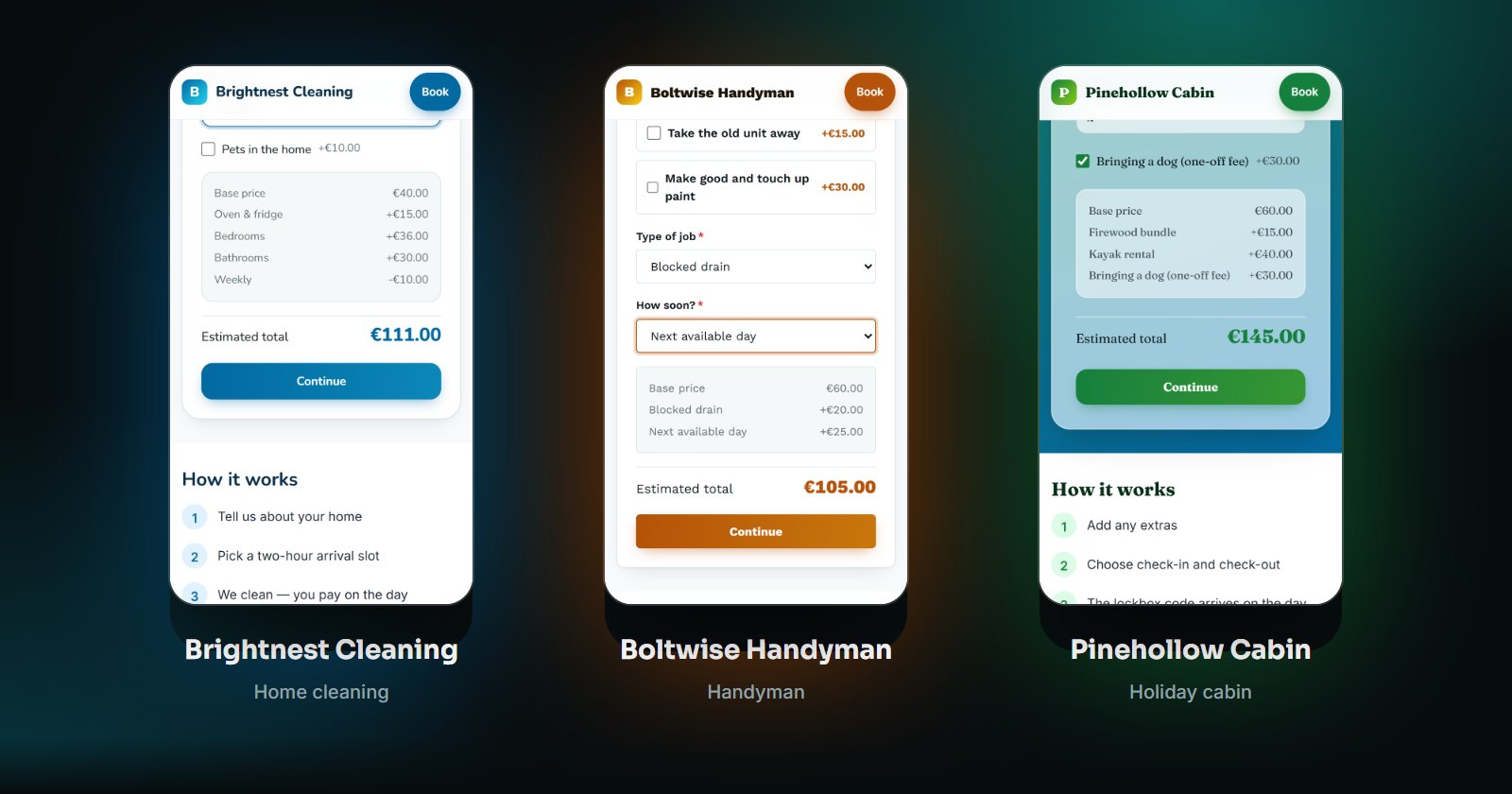
Every service business gets the same three questions before anyone books: how much, when, and how do I book? Answer them by phone or email and you lose hours every week — and every customer who doesn’t wait for the reply.
Here are three businesses that answer all three on their own website, without picking up the phone. The businesses are invented; the widgets are real. Every screen below is the working product, built from the same templates any new account starts with — in about ten minutes each.
1. The cleaning company: the first question is always the price
A clean is priced by the home: how many bedrooms and bathrooms, how often, which extras. So every enquiry starts with a back-and-forth before the customer even knows whether the price works for them — and many never write back.
 Brightnest Cleaning (a made-up example): price → time → booked.
- Template: Cleaning service. A base price plus a price per bedroom and per bathroom; a dropdown for how often, taking money off weekly and fortnightly cleans; extras such as the oven and fridge as tick boxes.
- Two-hour arrival slots, Monday to Saturday, with 30 minutes of travel kept free between jobs — so one crew can never be booked twice.
- The booking form asks for the address and access notes, so nobody has to call back for the gate code.
The result: the customer sees an exact price — €111 for a weekly clean of a three-bedroom, two-bathroom home, oven included — and books a slot that is genuinely free in under a minute. The owner gets everything needed to turn up.
2. The handyman: urgency is worth money — say so up front
Small jobs are where a tradesperson’s time goes: one call to describe the problem, another to agree a price, a third to agree a day. And “can you come tomorrow?” is worth more than “whenever you’re nearby” — it’s just awkward to say so on the phone.
 Boltwise Handyman (a made-up example): price → arrival window → booked.
- Template: Handyman call-out. A call-out fee that covers the first hour; a dropdown for the kind of job (a blocked drain costs more than a dripping tap); and a second for urgency, with a surcharge for next-day and same-day visits.
- Three-hour arrival windows instead of exact times — honest about how a working day goes, and still a promise the customer can plan around.
- Required questions for the address, a description of the job and whether someone will be in — so the right part is already in the van.
The result: a next-day visit for a blocked drain is €105, and the customer sees that before booking. Nobody has to haggle.
3. The holiday cabin: direct bookings, no commission
Booking sites bring guests — and take a cut of every stay, even from guests who already know you. A place with its own website can take those bookings directly, as long as the site can show the free dates and take a reservation.
 Pinehollow Cabin (a made-up example): extras → dates → reserved.
- Template: Cabin rental. The calendar works in whole days: the guest picks check-in and check-out, nights already booked can’t be chosen, and the minimum and maximum stay are enforced.
- Extras priced up front — firewood, a kayak, late check-out, a one-off fee for a dog — alongside the cleaning and linen fee.
- Priced per night: the guest picks the dates first, then the extras, and sees the full total — nightly rate × nights, plus extras — before booking.
 The same widget on a laptop: the glass theme takes on the page’s own colours.
What all three have in common
- Their own website, their own brand. Two lines of HTML, their colours and their font — no marketplace standing between them and the customer.
- One calendar that can’t be double-booked. Every slot is checked again on the server at the moment it’s booked.
- The price is worked out on the server from the owner’s own rules, so the booking holds exactly what the customer saw.
- The confirmation email goes out automatically, and reminders do once the owner switches them on — in the customer’s language: English, Hungarian or Serbian.
- Customers manage their own booking from the link in their email: move it or cancel it, within the owner’s rules.
Build yours in about ten minutes
- Sign up — 30 days of Pro, no card needed.
- Pick the template closest to your business and rewrite the labels in your own words.
- Set your prices, your hours and the questions you need answered.
- Paste the two lines into your website — or try it first on the built-in Test page.
Try it with your own prices Start from a template, change what you need, and see it on your own site today. 30 days of Pro, no card required. Start your free trial
Which business should we build next? Tell us in the comments — we’ll set it up and show it here.
Start your free trial
Also available in:
Három vállalkozás, egy widget: beállítások, amiket ma lemásolhat, Tri firme, jedan vidžet: podešavanja koja možete da preuzmete danas